Alan’s Hair Loss
Other PeopleAlan’s Hair Loss is more than a physical change: it becomes the visible focus of Alan’s shame, Russ’s taunts, and Mary Lamb’s growing pity. The narrative makes the fear concrete through secret pamphlets, the sudden loss of a pigtail, and, finally, a note whose subject is his hair. It connects Alan’s vulnerability to his strained relationships without establishing that hair loss alone causes his later death.
Appearance and Anxiety
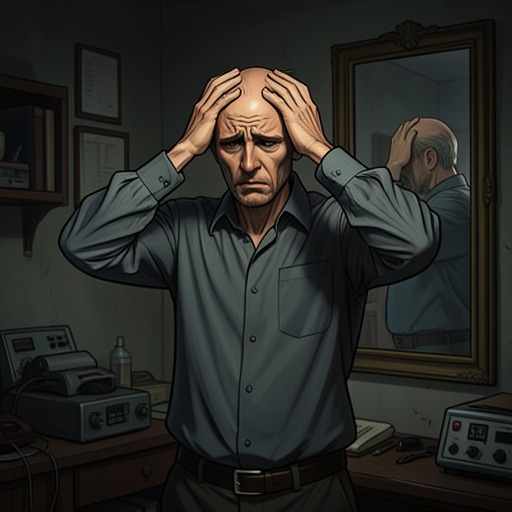
Alan keeps pamphlets about hair loss in a desk drawer, including guides to hair transplants and saving one’s hair, as well as a bluntly titled warning about going bald. Their presence shows that the problem occupies him privately before Russ exposes it. When Russ discovers the pamphlets and displays them, Alan spends the afternoon dizzy with distress. He later tells Mary Lamb that Russ cannot read or write, apparently expecting the fact to reassure or impress her; instead, Alan seems less pleased once he has shared it. The moment links his concern about his hair to his investment in the qualities that distinguish him from Russ, especially literacy.
The anxiety also shapes Alan’s attention to his appearance. While Mary Lamb reads in the garden, Alan watches her from the house and prepares to approach, but his attention is repeatedly drawn back to his hair. When she later passes him after spending time with Russ, Alan pulls out a whole pigtail. He looks at it in astonishment, and he and Mary Lamb recognize that he has only a few such handfuls left. The baldness he fears is no longer an abstract possibility or a subject confined to pamphlets; its progress becomes visible in an abrupt, ordinary gesture.
Russ’s Rivalry and Public Humiliation
Russ’s mockery is sharpened by a mix of jealousy and insecurity. He has been spending nights with Vera, but finds Alan and Mary Lamb coming to breakfast hand in hand. Their new pairing unsettles him, and his private thoughts turn toward Alan as a rival. Russ admires qualities Alan possesses, including his ability to read and write, while also worrying about his own standing after a remark from Vera. The narrative presents this resentment as part of the background to his revenge-minded brooding, rather than treating the hair taunts as isolated jokes.
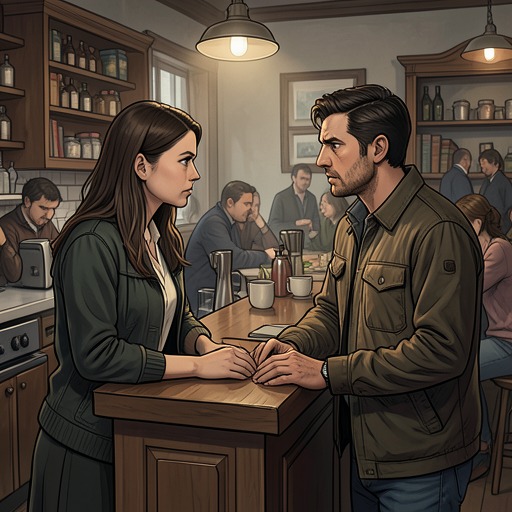
The garden incident gives Russ the opportunity to displace Alan. Alan approaches Mary Lamb hesitantly, but Russ arrives first; Mary puts down her book and spends time playing with him. Alan sees her return with Russ while he remains on the balcony, and his hair loss becomes an exposed vulnerability in the same scene as his romantic displacement. Later, in the communal sitting room, Russ boasts about his own body and ridicules Alan’s thinning hair in front of Mary Lamb. Alan answers only with shy, modest protests. The contrast is pointed: Russ turns the feature Alan tries to control in private into a spectacle for the household, while Alan cannot make the ridicule stop.
Mary Lamb’s Response and Their Relationship
Mary Lamb’s response is marked by sympathy, discomfort, and a sense of limited choice. When Alan tells her about Russ’s illiteracy, she responds with pity for Russ rather than affirming Alan’s apparent attempt to make the information significant. In the garden, she knows Alan wants to join her and also knows that she does not want his company in that moment. Russ’s ease around her makes the imbalance visible: she acknowledges that she can be comfortable with him, while Alan is left watching and worrying about his hair.
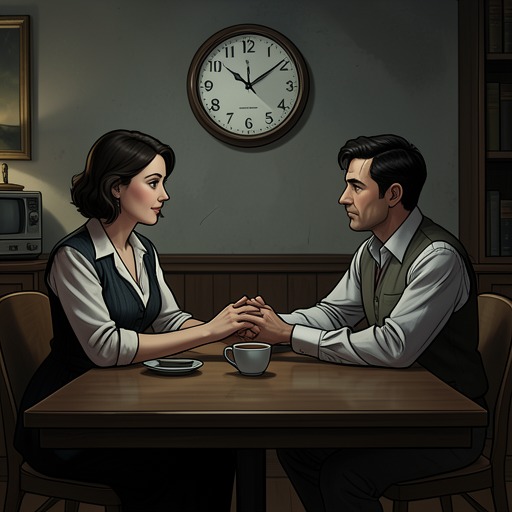
After Russ’s public humiliation of Alan, Mary Lamb takes Alan’s hand as they leave, partly to steady its shaking. The gesture is protective, but it does not resolve the strain between them. Alan’s fear about his hair is bound up with his sense of himself and with the intimacy he is trying to sustain; Mary Lamb, meanwhile, wishes he could stop worrying about it and feels sorry for him. Their relationship therefore offers no simple reassurance. Her compassion coexists with weariness, and his distress remains present between them rather than being eased by her care.
The Note and the Hair’s Final Significance
When Mary Lamb later enters Alan’s room and discovers that he has died, she finds a note on the table. The narrative says that it is all about his hair. This is the last explicit return to the subject and gives the earlier pamphlets, visible hair loss, and humiliations a grave retrospective weight. The evidence identifies the note’s topic, but does not establish that hair loss by itself explains Alan’s suicide; the distinction matters because his distress is shown within a wider crisis of love, rivalry, and self-regard.
The narrator then places Alan’s death in a reflection on youth, aging, and the passage of time: young people imagine death before old age, while the future can seem to stop in mist at twenty-five, yet aging arrives. That meditation broadens the meaning of Alan’s hair. It is a visible sign of time passing that he tries to resist, a source of shame that others exploit, and the subject he leaves behind in writing. Its recurrence gives the novel a concrete measure of his fear, while the note makes clear how persistently that fear occupied him.